
Theoretical Chemistry Group: Structure and Reactivity
The group for Theoretical Chemistry is using modelling techniques to understand the structure and reactivity of molecular and supramolecular systems or the interactions of molecules with other molecules or catalytic surfaces with the help of numerical simulations at different levels of theory ranging from molecular mechanics to ab initio methods. Also QSAR-QSPR studies are developed based on original approaches and using software developed in the house. The group is also tackling synthesis of challenging small molecules of theoretical interest and also kinetic studies aiming to unravel reaction mechanisms.

Dr. Isabela Traistaru (Man) is a level III senior researcher and leader of the Theoretical Chemistry group. She graduated in 2004 from the “Politehnica” University of Bucharest, Faculty of Engineering in Foreign Languages, Department of Chemistry. In 2006 she graduated from the same University the master degree in Biocompatible Systems, Materials and Substances. In 2011 she defended her Ph.D. thesis at the Technical University of Denmark, Center for Atomic scale Material Design. Her Ph.D. research, “Theoretical study of electro-catalysts for oxygen evolution” was developed under the supervision of professors Jens K. Norskov and Jan Rossmeisl. After returning in the country, she had a post-doc position at the University of Bucharest in the group of professor Vasile Parvulescu. In 2018 she won the “Nicolae Teclu “award of the Romanian Academy. In 2021 she won the L’Oréal Romania for Woman in Science Fellowship. Most of her published work concerns modelling interactions on catalytic surfaces but also supramolecular structures generated by halogen bonds or simulation of vibrational circular dichroism spectra (VCD). The main domain of research is computational chemistry applied in heterogeneous catalysis to understand from atomic point of view the chemical processes from the interface gas-solid and liquid-solid.

Dr. Mona-Irina Doana is a level III senior researcher. She graduated from the Polytechnic Institute of Iasi, The Faculty of Chemical Technology, Department of Organic Chemistry. In 2015 she obtained her Ph.D. from the “C.D. Nenitzescu” Center of Organic Chemistry of the Romanian Academy, with the subject “ Cycloaddition of cyan ketenes to oxyranic systems” She is specialized in fine organic synthesis, the study of reaction mechanisms and kinetics and valorization of renewable resources.

Dr. Carmen Mitan graduated and obtained her Master degree both from the “Politehnica” University of Bucharest, the Faculty of Industrial Chemistry in 1996 and 1997 respectivly. In 2003 she defended her Ph.D. thesis in chemistry, having the title “3+2 Cycloaddition Reactions of Allylic Dipoles”, at the “Costin D. Nenitzescu” Center of Organic Chemistry of the Romanian Academy. From 2003 until 2009 she had a post-doc position at the University of Illinois at Chicago in the group of professor Robert Moriarty focusing on the synthesis of azasugar with biological activity Her experience includes: organic synthesis of azasugar, coumarin dyes, heterocyclic compounds via sydnones, műnchnones, N-ylides; atropisomerism and helical chirality, stereochemistry of 1,3-dipolar cycloaddition reactions, chemistry of the Mo- and Ru-carbenes, using 3-Sphere and Lie group theories in conformational analysis. Besides chemistry she enjoys reading and walking outdoors.

Dr. Mihai Deleanu obtained his Bachelor of Science degree in Chemical Engineering (English department), Specialization in Organic Chemistry, Faculty of Engineering in Foreign Languages at Politehnica” University of Bucharest in 2014 and the Master of Science degree in Chemical Engineering, Specialization in Pharmaceutical and Cosmetic Products, Faculty of Applied Chemistry and Materials Science from the same university in 2016. In 2022 he obtained his Ph.D. in Chemistry and Physical Chemistry of Materials from the Institut des Biomolécules Max Mousseron, Université de Montpellier. His experience includes: organic synthesis of optically active α-keto aziridines , syntheses of N-based ligands for obtaining supramolecular networks and receptors with molecular recognition properties; purification, crystal growth and characterization of the obtained compounds via NMR, IR, UV, HPLC, MS; solid-phase peptide synthesis (SPPS), physico-chemical characterization and mechanistic investigation of biological systems with a notable experience in the aggregation process of β-amyloid peptides using Taylor Dispersion Analysis (TDA), dynamic light scattering (DLS), capillary electrophoresis (CE) and fluorescence assays. Beyond chemistry, he enjoys getting out in nature and goes skiing every time he gets a chance.

Ana Maria Hanaru (Sezonov) graduated from the “Politehnica” University of Bucharest, Faculty of Organic Chemical Technology, Department of Engineering Sciences, English subsection in 1996. In 2012 she graduated from the second University, the University of Bucharest, Faculty of Journalism and Communication Studies. In 2014 she graduated from the same University the Master Francofone degree and in 2022 she defended her Ph. D thesis in the same area of study. Ana-Maria is specialized in fine organic synthesis of benzocyclobutadiene, in valorization of renewable resources. Beside chemistry she is passionate by the art and communication techniques.

Andrei Pantea is bachelor student in his 3rd year at the University of Bucharest, Faculty of mathematics. His specialization is in applied mathematics and in python computer programming. In this group he is involved in developing applications for graph theory for organic chemistry, the deconvolution of 1H-NMR spectra of biological fluids and development of algorithms for machine learning for their interpretation.

Raluca Jalba is a master student at the University of Bucharest, Faculty of Chemistry, Department of Catalysis. She is involved in doing simulations in catalysis using ab initio methods.

Dr. Petru Filip is a senior resercher level I with more than 50 years’ experience in basic and applied research and in process development and technology transfer to industrial level of laboratory synthesis procedures. Hi published moe than 100 scientific papers and supervised 12 Ph. D. theses. His expertise includes fine organic synthesis, developmet and transfer of technologies, molecular modeling, industrial process modeling, QSAR-QSPR studies and software development. He was enjoying climbing and skiing but now cooking and MMORPG computer games are filling his spare time.

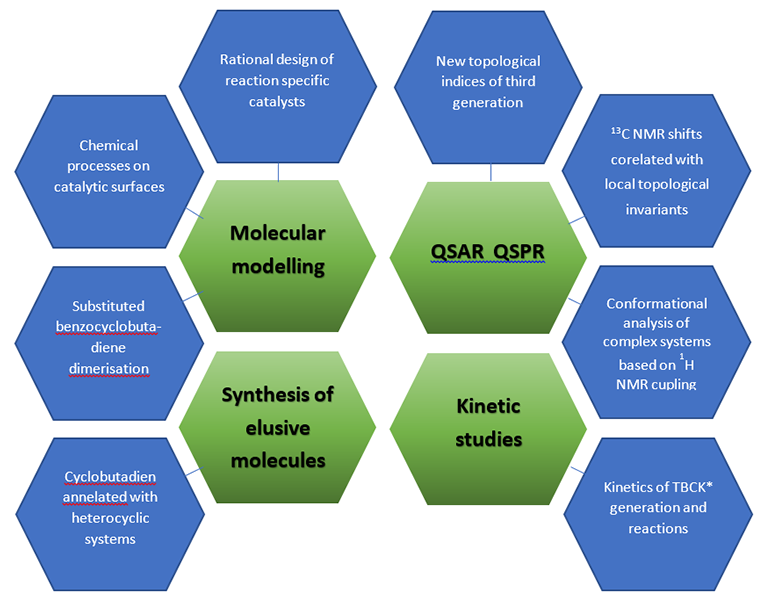
* tert-Butyl Ciano Ketene (TBCK)
Rational design of catalytic materials and chemical processes on catalytic surfaces
Two main subjects are centered around modeling the oxygen reduction reaction (ORR) and water oxidation/oxygen evolution reaction (OER) on the catalyst’s surfaces using ab initio methods. There are still many challenges related to these two subjects, mainly because are related to renewable sources of energies and of which performances has to be increased in terms of activity, selectivity, stability and cheap materials. Understanding from atomistic point of view are still vital in designing new materials. In this direction collaboration with the experimentalists from the University of Bucharest is established (Faculty of Chemistry and Faculty of Physics). The main catalysts we are studying are various structures of graphene (ex. doped and undoped nanoribbons and graphene quantum dots) for ORR and various oxide materials (ex. oxide clusters) for OER.
We intend in the near future to start similar research for CO2 reduction to valuable chemical compounds – such as methanol, methane, hydrocarbons, formic acid. These are key compounds for the chemical industry and nowadays are obtained from fossil fuels (oil, charcoal). Therefore, using CO2 as a resource represents an important contribution to the anthropogenic cycle of carbon.
Another class of catalytic materials for various applications in organic (ex. oxidation of methane to methanol, hydrogenation of aromatic ketones etc) and inorganic synthesis (ex. water oxidation) are MXenes. This is a new class of 2D materials of a high structural complexity and chemical diversity. Because presently their investigation is at beginning, we intend to start studying these materials from theoretical point of view.
The chemistry of cyclobutadienic systems
Although this subject is considered out of the actual interests in science, there are still research opportunities. One can consider that the systems in which the cyclobutadiene is condensed to the aromatic heterocycles are still unstudied with the exception of the type 1 systems. These actually are not cyclobutadienes, but exo-methylenic systems.

Our purpose is to develop new synthesis routes which can allow us to obtain the 2 type systems. In the meantime, we will model using the quantum chemistry methods possible dimerization routes for these systems.
Theory of graphs applied in chemistry
In this subprogram we develop new topological indices of 3rd generation, based on the matrices associated to the molecular graphs including the line graphs. These new indices are used to be correlated with molecular properties and also with local properties from inside the molecule (ex. chemical shifts in 13C NMR spectra). Also we will study the relations between the molecular structures and the coupling constants from 1H NMR using complex mathematical modeling.
Kinetic and mechanism of organic chemistry
The main objective of this research domain is to use H1 NMR spectroscopy to determine constant rates of organic reactions. These constants are used to build reaction mechanisms. In the beginning this technique will be used to study the reactions of tert-butylcyanoketene.
Published papers: 2017-2022
1. “Rectangle as manifold on relationships between vicinal constant couplings 3JHH, 1H, 13C-chemical shifts and dihedral angles”, CI Mitan, E Bartha, C Draghici, MT Caproiu, P Filip. RM Moriarty
Revue Roumaine de Chimie 67 (3), 171-176, 2022, DOI: 10.33224/rrch.2022.67.3.05
2. “Tetrahedral angles of five membered ring iminocyclitols with ribitol stereochemistry beyond the dihedral angles”, CI Mitan, E Bartha, C Draghici, MT Caproiu, P Filip, RM Moriarty
Revue Roumaine de Chimie 67 (3), 165-170, 2022, DOI: 10.33224/rrch.2022.67.3.04
3. ”Hopf Fibration on Relationship Between Dihedral Angle θHnHn [deg] and Vicinal Angle ϕ [deg], Angles Calculated from NMR Data with 3-Shere Approach and Java Script”, CI Mitan, E Bartha, C Draghici, MT Caproiu, P Filip, RM Moriarty
Science Journal of Chemistry 10 (1), 21-31, 2022, DOI: 10.11648/j.sjc.20221001.13
4. ”Engineering hydrogenation active sites on graphene oxide and N-doped graphene by plasma treatment”, M Magureanu, NB Mandache, C Rizescu, C Bucur, B Cojocaru, IC Man, A. Primo, VI Parvulescu, H Garcia
Applied Catalysis B: Environmental 287, 119962, 2021, DOI: 10.1016/j.apcatb.2021.119962
5. ”Benzimidazolium salts as starting materials or intermediates in 1, 3-dipolar cycloadditions”,
AM Macsim, E Georgescu, F Georgescu, P Filip, A Nicolescu, C Deleanu
Monatshefte für Chemie-Chemical Monthly 152 (7), 845-852, 2021, DOI: 10.1007/s00706-021-02795-7
6. ”Program for prediction dihedral angle from vicinal coupling constant with 3-sphere approach”
E Bartha, CI Mitan, C Draghici, MT Caproiu, P Filip, RM Moriarty
Rev. Roum. Chim 66 (2), 179-183, 2021, DOI: 10.33224/rrch.2021.66.2.08
7. “Dihedral angles calculated with 3-sphere approach as integer in conformational analysis on d-,l- ribitol series
CI Mitan, E Bartha, P Filip, C Draghici, MT Caproiu, RM Moriarty
Rev. Roum. Chim. 66 (12), 941-948, 2021, DOI: 10.33224/rrch.2021.66.12.07
8. “Oxygen evolution reaction: a perspective on a decade of atomic scale simulations”
S Divanis, T Kutlusoy, IMI Boye, IC Man, J Rossmeisl
Chemical science, 11, 2943-2950, 2020 , DOI: 10.1039/C9SC05897D
9. “First principle studies of oxygen reduction reaction on N doped graphene: Impact of N concentration, position and co-adsorbate effect”
IC Man, I Trancă, SG Soriga
Applied Surface Science, 510, 145470, 2020, DOI: 10.1016/j.apsusc.2020.145470
10. “5-Iodo-1-arylpyrazoles as potential benchmarks for investigating the tuning of the halogen bonding”
D Dumitrescu, S Shova, IC Man, MR Caira, MM Popa, F Dumitrascu
Crystals 10 (12), 1149, 2020 , DOI: 10.3390/cryst10121149
11. “Nanometer-thick films of antimony oxide nanoparticles grafted on defective graphenes as heterogeneous base catalysts for coupling reactions”
A Simion, N Candu, B Cojocaru, S Coman, C Bucur, A Forneli, A Primo, IC Man, VI Parvulescu, H Garcia
Journal of Catalysis 390, 135-149, 2020, DOI: 10.1016/j.jcat.2020.07.033
12. “How Do the Coadsorbates Affect the Oxygen Reduction Reaction Activity of Undoped and N-Doped Graphene Nanoribbon Edges? A Density Functional Theory Study”
DL Isac, SG Soriga, IC Man
Journal of Physical Chemistry C 124 (42), 23177-23189, 2020, DOI: 10.1021/acs.jpcc.0c06716
13. “A theoretical study of the influence of gold nanoplatelets sites in CC coupling reaction”
IC Man, SG Soriga
Molecular catalysis 485, 110845, 2020, DOI: 10.1016/j.mcat.2020.110845
14. “Halogen bonding in 5-iodo-1-arylpyrazoles investigated in the solid state and predicted by solution 13C-NMR spectroscopy”
MM Popa, IC Man, C Draghici, S Shova, CR Mino, D Florea, D Dumitrescu
CrystEngComm, 7085-7093,2019, DOI: 10.1039/C9CE01263J
15. “Nitrogen-doped graphene as metal free basic catalyst for coupling reactions”
V.I. Parvulescu, N. Candu, I. C. Man, A. Simion, B. Cojocaru, S. M. Coman, C. Bucur, A.Primo
Journal of Catalysis 376, 238-247, 2019, DOI: 10.1016/j.jcat.2019.07.011
16. “Effects of the cooperative interaction on the diffusion of hydrogen on MgO (100)”
IE Castelli, SG Soriga, IC Man
The Journal of chemical physics 149 (3), 034704, 2018, DOI: 10.1063/1.5029329
17. “Effect of Ca and Sr in MgO (100) on the activation of methanol and methyl acetate
IC Man, SG Soriga, VI Parvulescu”
Catalysis Today 306, 207-214, 2018, DOI: 10.1016/j.cattod.2017.03.062
18. “Role of the band gap for the interaction energy of coadsorbed fragments”
IE Castelli, IC Man, SG Soriga, V Parvulescu, NB Halck, J Rossmeisl
The Journal of Physical Chemistry C 121 (34), 18608-18614, 2017, DOI: 10.1021/acs.jpcc.7b04974
19. “Theoretical aspects of methyl acetate and methanol activation on MgO (100) and (501) catalyst surfaces with application in FAME production”
IC Man, SG Soriga, V Parvulescu
Applied Surface Science 392, 920-928, 2017, DOI: 10.1016/j.apsusc.2016.09.114
NanoCatDFTOERR
DFT calculations as design tool for OER and ORR nanocatalysts for renewable energy applications
PN-III-P1-1.1-TE-2021-0931