
The research carried out within the Bioresources and Sustainable Organic Chemistry (BioCOS) department considers, on the one hand, the recycling and transformation of waste obtained in daily activities into new products with added value, and on the other hand, the valorization of natural resources through chemical methods by using green solvents, heterogeneous catalysis or non-conventional methods, in order to obtain intermediates and various materials of interest (plasticizers, lubricants, oleogels, resins etc.).
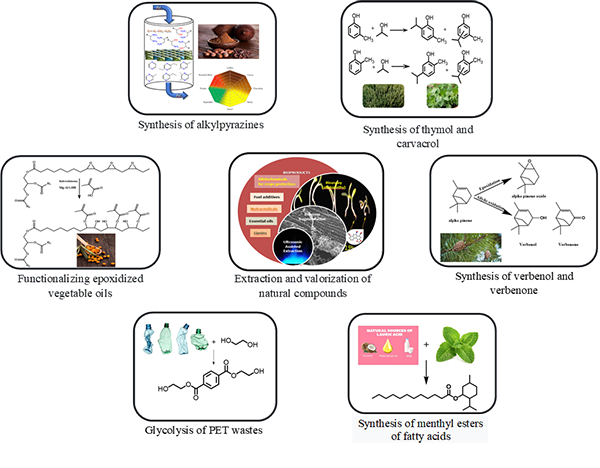
Research topics:
Valorization of bioresources – replacing petrochemical-based products with materials and intermediaries obtained through the valorization of renewable resources (e.g. chemically functionalized vegetable oils, the obtaining of various fatty acid menthyl esters etc.). Durable systems for biomass processing using ultrasound (e.g. the fragmentation of lignocellulose).
Valorization of secondary products from industry – Conversion of secondary compounds resulting from industrial processes into added value products (e.g. alkylpyrazines used in the food industry starting from fusel oil from the alcoholic fermentation process; derivatizations of glycerine to fuel additive compounds for the sustainable integration of biodiesel production).
Valorization of wastes – conversion of end-of-life products into materials useful in everyday life (e.g. transformation of PET waste into various types of polyurethane foams using the glycolytic method coupled with the transesterification reaction using green catalysts).


Researcher with experience in organic synthesis and analytical techniques for identification, separation, and characterization of different chemical compounds (GC-MS, HPLC-MS, NMR, VCD). Advanced knowledge in both the field of stereochemistry and enantioselective syntheses (TADDOLI synthesis) as well as in organic syntheses using heterogeneous catalysis (obtaining of thymol and carvacrol, synthesis of N-oxides and pyrylium salts). She has been part of numerous research projects having various topics, being both a team member and project director.

Researcher with extensive experience in organic synthesis and organic compound technology having many approved technological processes (total synthesis of vitamin E, synthesis of odorants, synthesis of liquid membranes, etc.). He has coordinated numerous research projects having the main subject the recycling of PET waste through innovative chemical methods to obtain polyurethane foams of various types. Advanced expertise in analytical techniques, such as titrimetry, gravimetry, GC, HPLC, spectroscopy (NMR, IR, UV-Vis).

Researcher with experience in modern applications of ultrasound in biomass processing science and technology and structure elucidation of natural compounds by spectroscopy methods. Expertise in efficient methods for extraction of compounds with biological activity (nutraceuticals and pharmaceuticals, bioherbicides) and in bioassay-guided separation of biologically active substances (alelochemical compounds).

PhD student with knowledge in functionalizing vegetable oils using heterogenous catalysis and characterizing the obtained compounds. Extraction of natural compounds and their characterization using spectroscopy (IR, NMR) and cromatography methods (HPLC).

PhD student with knowledge in synthesis and characterization of nanostructured lipid carriers (NLCs), valorization of PET waste using innovative environmentally friendly catalysts, extraction of natural compounds. Characterization of the obtained compounds using spectroscopy methods (IR, NMR).

Master degree student with knowledge in the valorization and functionalization of vegetable oils and the characterization of the obtained compounds, obtaining oleogels with sun protection factor starting from vegetable oils.


PATENTS
- M. Duldner, S. Căpitanu, B. Cursaru, A. Sârbu, S. Apostol, E. Bartha, S.F. Ion, S. A. Gârea, M. Ionescu, “Oligoester-polioli din deşeuri de polietilentereftalat şi materiale regenerabile, procedeu de obţinere a acestora, şi compoziţie pentru spume poliuretanice stropite, încorporând respectivii oligoesteri-polioli”, RO 133049 B1, 30.03.2021
- M. Duldner, S. Iancu, S. Căpitanu, E. Bartha, S. Nica, A. Sârbu, M. Ionescu, S. A. Gârea, “Oligoester-polioli aromatic-aromatic alifatici din deșeuri de polietilentereftalat și monomeri provenind din resurse regenerabile, și procedeu de obținere a acestora”,
RO 131976 B1, 30.06.2021 - M. M. Duldner, A. M. Coman, T. V. Iordache, A. Sârbu, E. Bartha, R. Țincu, A. Ghebaur, C. M. Damian, G. Surdu, A. Savastre, “Compozite politester-eter polioli/montmorilonit pentru spume poliuretanice semiflexibile (nano)compozite și procedeu de obținere a acestora”, A2019-0845.
PATENT APPLICATIONS
- M. Duldner, A. M. Coman, T. V. Iordache, A. Sârbu, E. Bartha, R. Țincu, A. Ghebaur, C. M. Damian, G. Surdu, A. Savastre, “Compozite politester-eter polioli/montmorilonit pentru spume poliuretanice semiflexibile (nano)compozite și procedeu de obținere a acestora”, RO 135061 A2, 30.06.2021
- M. Duldner, A. M. Coman, T. V. Iordache, A. Sârbu, E. Bartha, F. Teodorescu, A. Ghebaur, V. I. Chițulescu, G. Surdu, S. Popa “Polioli cu structura poliester-amidică conținând unități structurale mezogene pentru spume poliuretanice semiflexibile și procedeu de obținere a acestora”, RO 135066 A2, 30.06.2021
- Plant-Based Resins Obtained from Epoxidized Linseed Oil Using a MgAl Hydrotalcite Catalyst, A. Slabu, N.D. Banu, B. Balanuca, F. Teodorescu, R. Stan, U.P.B. Sci. Bull., Series B, 2022, 84, 45
- Metal-containing Ionic Liquids as Catalyst in PET Glycolysis, R. Țincu, A. Slabu, C. Stavarache, M.M. Duldner, E. Bartha, F. Teodorescu, Mater. Plast., 2022, 59, 1
- DES-Based Biocatalysis as a Green Alternative for the l-Menthyl Ester Production Based on l-Menthol Acylation, Ion, F. Olănescu, F. Teodorescu, R. Țincu, D. Gheorghe, V.I. Pârvulescu, M. Tudorache, Molecules, 2022, 27, 5273,
DOI: 10.3390/molecules27165273 - Novel Polyurethanes Based on Recycled Polyethylene Terephthalate: Synthesis, Characterization, and Formulation of Binders for Environmentally Responsible Rocket Propellants, F.M. Dîrloman, G. Toader, T. Rotariu, T.V. Țigănescu, R.E. Ginghină, R. Petre, F. Alexe, M.I. Ungurean, E. Rusen, A. Diacon, A. Ghebaur, M. Dudlner, A.E. Coman, R. Țincu, Polymers, 2021, 13, 3828, DOI: 3390/polym13213828
- Dye Removal from Wastewaters using Grape Seed Residues, R. Ținu, C. Todașcă,
Artem, A.-I. Nicoară, Rev. Roum. Chim., 2021, 66, 185,
DOI: 10.33224/rrch.2021.66.2.09 - Vapor Phase Synthesis of Alkylpyrazines Over ZnAl Mixed Oxide Derived from Layered Double Hydroxides Obtained by the Mechanochemical Method,
Teodorescu, A. I. Slabu, O. D. Pavel, React. Kinet. Mech. Catal., 2021, 133, 863, DOI: 10.1007/s11144-021-02013-9 - A Comparative Study on the Catalytic Activity of ZnAl, NiAl, and CoAl Mixed Oxides Derived from LDH Obtained by Mechanochemical Method in the Synthesis of 2-Methylpyrazine, F. Teodorescu, A. I. Slabu, O. D. Pavel, R. Zavoianu, Catal. Commun., 2020, 133, 105829, DOI: 10.1016/j.catcom.2019.
- Attempts to Upcycle PET Wastes into Bio-based Long-lasting Insulating Materials,
Duldner, E. Bartha, S. Căpitanu, S. Nica, A.E. Coman, R. Țincu, A. Sârbu, P.I. Filip, S. Apostol, S. Garea, Rev. Chim., 2019, 70, 2301, DOI: 10.37358/RC.19.7.7328 - Functionalized 1,5,7-triazabicyclo[4.4.0]dec-5-ene (TBD) as Novel Organocatalyst for Efficient Depolymerization of Polyethylene Terephthalate (PET) Wastes, S. Nica, M. Duldner, A. Hanganu, S. Iancu, B. Cursaru, A. Sârbu, P. Filip, E. Bartha, 2018, 69, 2613, DOI: 10.37358/RC.18.10.6591
- Mechanistic Investigations of the Organocatalytic Depolymerization of PET Waste with Isosorbide, S. Nica, S. Ionescu, A. Hanganu, M. Duldner, S. Iancu, A. Sârbu, P. Filip, E. Bartha, Rev. Chim., 2018, 69, 1319, DOI: 10.37358/RC.18.6.6318
- Selective alkylation of m-cresol with isopropyl alcohol under
solvent-free conditions, F. Teodorescu, A. Enache, M. Săndulescu,
Arkivoc, 2017, part v, 58, DOI: 10.3998/ark.5550190.p009.943 - Glycolytic Depolymerization of Polyethylene Terephthalate (PET) Wastes – organic vs. metal-catalysis, S. Nica, A. Hanganu, A. Tănase, M. Duldner, S. Iancu, C. Drăghici, P.I. Filip, E. Bartha, Rev. Chim., 2015, 66, 1105
- Addition of Alcohols to Acrylic Compounds Catalyzed by Mg–Al LDH, F.
Teodorescu, M. Deaconu, E. Bartha, R. Zăvoianu, O. D. Pavel, Catal.
, 2014, 144, 117, DOI: 10.1007/s10562-013-1108-1 - Memory effect of hydrotalcites and its impact on cyanoethylation reaction, F. Teodorescu, A. M. Pălăduță, O. D. Pavel, Mater. Res. Bull., 2013, 48, 2055, DOI: 10.1016/j.materresbull.2013.02.018
- Glycolysis of PET Wastes with Isosorbide – Identification and Characterization of Hydroxy Oligoesters, E. Bartha, S. Iancu, M. Duldner, M.D. Vuluga, C. Drăghici, F. Teodorescu, D. Gherase, Rev. Chim., 2011, 62, 401
Environment friendly technology for obtaining polyester polyols for polyurethane spray foams from PET wastes and renewable raw materials - PN-III-P2-2.1-PTE-2019-0355 (contract 46PTE/2020) - https://www.icpaomedias.ro/index.php/proiecte-in-derulare/ecorepol
Abstract: This project aims to develop an industrial pilot scale ecological technology for the synthesis of oligoester-polyols with directed chemical structure and designed properties, so that they are suitable for use as intermediates in obtaining sprayed rigid polyurethane (PUR) foams, through chemical recycling of polyethylene terephthalate (PET) waste, using renewable co-monomers as splitting and/or chemical modification agents, or which can be obtained from renewable materials through biochemical and/or chemical processes, in the presence of organic catalysts, in order to increase the performance of the process, energy efficiency and to avoid contamination of the products with heavy metals. The laboratory scale technology for the synthesis of polyester-polyols from PET waste and renewable materials in the presence of organic catalysts was developed by the collaboration between the “C.D.Nenitzescu” Institute of Organic and Supramolecular Chemistry of the Romanian Academy (ICOSCDN) and the National Institute for Research & Development in Chemistry and Petrochemistry (ICECHIM) within a PN-II project and, based on it, an invention patent application was submitted to OSIM. The project aims to improve the technology, in the sense of maximizing the content of PET waste and renewable monomers in the chemical composition of polyester-polyols and optimizing the reaction parameters for the maximum economic and energetic efficiency of the process, as well as the development and validation of the technology at an industrial pilot level at the economic agent partner the Institute of Research for Organic Auxiliary Products (ICPAO) Mediaș, by demonstrating functionality in real operating conditions, testing the product to obtain sprayed polyurethane foams in real operating conditions (by an economic agent producing sprayed polyurethane foams as a service employed with third parties), and validating the compliance of their characteristics to those of standard sprayed PUR foams.
Deep eutectic solvent-based biocatalysis for the production of menthol natural derivatives as flavours/fragrances with applicability in food industry - PN-III-P2-2.1-PED-2019-4561 (contract : 376PED/2020) - https://www.chimie.unibuc.ro/cercetare/cataliza/PN-III-P2-2_1-PED-2019-4561/
Abstract: The BIOMENTH project proposes the development, optimization and validation of a feasible biocatalytic method (lipase biocatalyst) based on the use of a deep eutectic solvent (DES) environment for the production of (-)-menthol derivatives with enriched aroma properties, which is of real interest for the food industry. BIOMENTH proposes an enzymatic method for the acylation of (-)menthol with fatty acid type structures (of interest omega 3/6/9 fatty acids) to fatty acid esters (MEFA). MEFA products are important for the food industry because they combine the flavouring properties of (-)-menthol with the healing properties of fatty acids (omega 3/6/9). In addition, MEFA provides a gradual release of flavour through the hydrolysis of the ester group and at the same time a rapid cell membrane penetrating action involving easy digestion.
The proposed enzymatic method involves the action of the lipase enzyme in immobilized form (covalent immobilization model, CLEA and/or CLEMPA), which will act in a DES environment for the acylation of (-)-menthol with fatty acid-type structures. The DES medium will be made by efficiently mixing the menthol and the acylating agent. The reaction will start when the enzyme is added to the system. In addition, BIOMENTH proposes the optimization and validation of the biocatalytic method for future industrial use.